As a Course participant you will have access to all Course Material for 6 weeks
Part 1 serves as an introduction to Pharyngeal High-Resolution Manometry-Impedance (P-HRM-I) technology, focusing on providing insights into swallowing function and dysfunction through pressure and impedance plots. This section is particularly beneficial for those new to pharyngeal manometry and aiming to learn how to operate Swallow Gateway.
Part 2 is centered around guiding users on how to effectively use the Swallow Gateway for analyzing manometry-impedance recordings. In order to complete the exercises in Part 2 of the Course, participants will need an active Research Associate or Clinical Associate Level subscription.
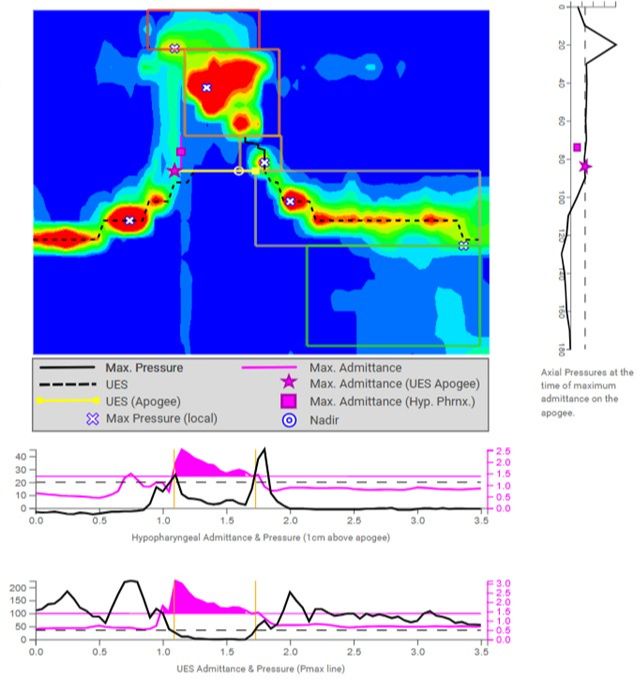
Part 3 is tailored to educate users on interpreting Swallow Gateway plots and data, with a focus on leveraging Pharyngeal HRM-derived information for diagnostic purposes. This section is intended for trained professionals such as physicians, speech pathologists, nurses, scientists, and technicians involved in diagnostic swallowing assessments.
The final part, Part 4, delves into the Leuven Consensus, which outlines classification schemes for diagnosing pharyngeal and upper esophageal sphincter (UES) motor disorders based on metrics derived by P-HRM-I.
A Certificate of Completion is available on request, which includes a summary of the Course learning outcomes.
NOTE: This Course is not accredited to assess competency in using pharyngeal high-resolution manometry for clinical diagnosis.
Curriculum
- Introduction
- Important Information
- How to Use Swallow Gateway for Pharyngeal Analysis (47:41)
- Swallowing Function Data on Swallow Gateway
- Understanding Key Metrics of Pharyngeal Contractility
- Understanding Key Metrics of UES Function (1:01)
- Understanding Patterns and Metrics of Bolus Transit and Global Function
- Pharyngeal Manometry Video Library (248:43)
- How to Use Swallow Gateway for Esophageal Analysis (12:03)
- Understanding Key Metrics of Esophageal Function (181:47)
- Esophago Gastic Junction Analysis and Metrics (4:35)
- Diagnosis of UES Dysfunction (21:00)
- UES Dysfunction Algorithm Navigator
- Case 1 - Clinical History and Results
- Case 1 - Analysis and Guidance
- Pharyngeal Contractile Dysfunction
- Pharyngeal Contractile Dysfunction Algorithm Navigator
- Case 2 - Clinical History and Results
- Case 2 - Analysis and Guidance
- Integrating the Diagnoses of UES and Pharyngeal Contractile Dysfunctions
- Leuven Consensus Full Navigator
- Navigator Results - Cases 1 & 2
- Instructions
- Case 3 - Clinical History and Results
- Case 3 - Analysis and Guidance
- Case 4 - Clinical History and Results
- Case 4 - Analysis and Guidance
- Case 4 - Results Revisited
- Case 4 Revisited - Analysis and Guidance
- Case 5 - Clinical History and Results
- Case 5 - Analysis and Guidance
- Case 6 - Clinical History and Results
- Case 6 - Analysis and Guidance
- Case 7 - Clinical History and Results
- Case 7 - Analysis and Guidance
- Case 8 - Clinical History and Results
- Case 8 - Analysis and Guidance
- Case 9 - Clinical History and Results
- Case 9 - Analysis and Guidance
- Case 10 - Clinical History and Results
- Case 10 - Analysis and Guidance